


MULTI-FUNCTION KNIFE - SHUTTLE FOLDING - NONTRON
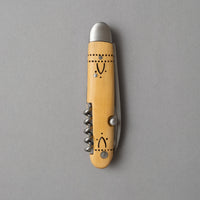
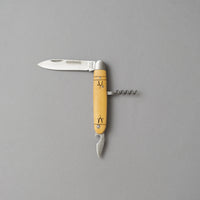
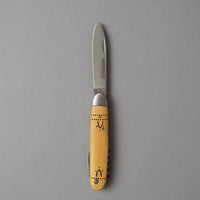
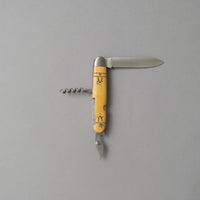
Navette folding knife, a great classic of Nontronnaise cutlery.
Sandvick stainless steel blade, pyrographed boxwood handle, equipped with a corkscrew, bottle opener and can opener.
The revival of the oldest French knife, the mythical knife marked with the 3-point V, a mysterious symbol whose origin no one knows anymore..!
A tool for all uses, an indispensable attribute of farmers, a companion to every meal, the Nontron has spanned the ages since the 15th century.
Even today, the 40 stages of manufacturing remain the same. Handcrafted, each knife is entirely made by the same craftsman.
The artisanal company currently has around twenty cutlers, it is labeled Living Heritage Company.
Blade length: 8 cm
Handle length: 10 cm
Weight: 72g
La Coutellerie Nontronnaise, heir to an immemorial expertise, is a staple of the French regional knife landscape. A Nontron represents our territory and our craftsmanship.
The Nontron knife is considered an ancestor and inspires numerous legends. This imagery, dating back to the dawn of time, relies as much on its unique shapes as on its distinctive pyrography mark.
Its history is so long that it is difficult to date its birth. However, experts agree that the Nontron knife is the oldest knife in France and that its origin dates back at least to the 15th century.
Writings and excavations indicate that, well before the Middle Ages, forging was already common in this French region. Guillaume de la Villeneuve alluded to the "knives of Périgord" at the beginning of the 13th century.
Subsequently, blacksmiths were praised for their skills in poems and songs. Some historians claim that King Charles VII (1403-1461), called "the Victorious" by Joan of Arc, may have had his sword made in Nontron.
In the 18th century, Nontron had thirty-five cutlers. In 1928, only one company remained: La Coutellerie Nontronnaise. On June 21, 2000, a new workshop designed by Luc-Arsène Henry opened its doors.
La Coutellerie Nontronnaise remains the only one to perpetuate this centuries-old tradition. Each piece, made from start to finish by the same cutler, is unique. From the branch of boxwood (dried for a minimum of 4 years on site) to the finished knife, it takes 40 manufacturing steps: the main ones being sawing, grooving the blank, fitting the iron ferrule and nail, installing the rotating brass or nickel-silver ferrule, applying the hallmark, grinding the spine, sanding and then polishing the handle, and sharpening the forged blade (since 1992, all blades have been produced by Forge de Laguiole).
Then one operation remains: pyrography. These motifs, whose origin and meaning are still unknown, consist of 6 "flies": a type of inverted V framed by 3 dots and 4 rows of small dots.
Defending and buying a Nontron means taking part in a process that rejects the loss of skills and participating in the demonstration that a product made entirely by hand in France can still exist.