
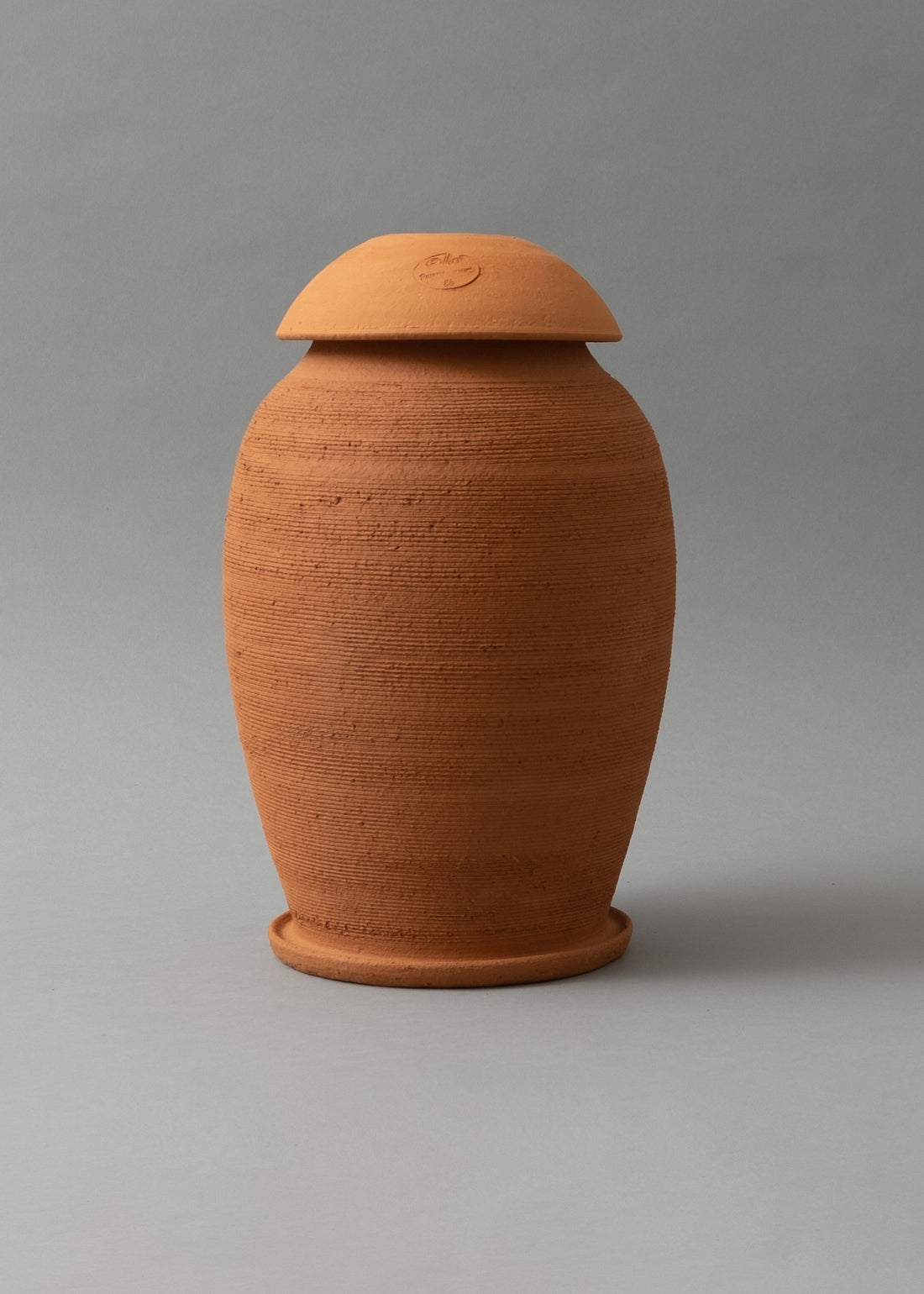


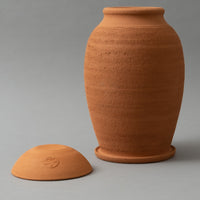
BEE WATERER - OLLAS BEE NO. 5 - 9 liters - POTERIES JAMET
Capacity: 9 L
Diameter x Height: 25.5 x 37 cm
Average duration: 6/8 days
For beehives and wild bees. Recommended model for 2 to 4 hives.
To support the work of these tireless workers, sentinels, and key biodiversity indicators, and to help combat the growing collapse of their colonies, the Ollas Bee is the only natural system for watering bees with quality water, on demand and close by, regardless of the climate or environment, and without any risk of drowning.
Throughout their lives, bees need water to produce larval food (royal jelly) and propolis (a defense against diseases), to dilute honey, and to regulate the temperature of the hive.
The Ollas Bee helps reduce the bee mortality rate caused by exhaustion from water foraging and the risk of drowning, as well as exposure to chemical pollution from contaminated water (pesticides, soil treatments, and wastewater).
Place on the ground or on a stand, fill with water, and position near hives or your plantings. Leave in place throughout the year.
A bee colony with an Ollas Bee enables a harvest of 2 to 3 times more honey, with a reduced mortality rate.
Laurent Jamet, heir to a long family tradition of potters, works the clay entirely by hand. Except for grinding and mixing the clay, there are no machines in the workshop.
Raw earth extracted from 100% French quarries. Frost resistant.
Handcrafted in Anjou, France.
Collecting water using an OLLAS-BEE Jamet® provides several benefits for bees: less fatigue, better hydration, vitality, and health. This results in a longer life expectancy for them, while reconciling high and qualitative honey production.
- Less stress for collection, with quality water available at will and nearby.
- Reduction in the bee mortality rate due to exhaustion and the dangers of water collection, including the risk of drowning.
- Reduction in bees' exposure to chemical pollution from contaminated water (pesticides, soil treatments, urban wastewater, etc.).
- These water "workers," generally experienced older foragers, have more time to collect water with better efficiency. This improves their vitality and extends their lifespan.
- They will be partially reassigned to pollen harvesting, allowing for an increase in its harvest and therefore the amount of honey for winter reserves..., thus strengthening the health and number of bees for stronger colonies.
- Indeed, having quality water in sufficient quantity nearby, with an OLLAS-BEE Jamet®, allows bees to cool the hive more quickly and more easily produce honey, royal jelly, propolis, and wax for building honeycomb cells.
- A bee colony with an OLLAS-BEE Jamet® harvests 2 to 3 times more honey than a colony without an OLLAS-BEE Jamet®, with a reduced mortality rate.
For more information, click: here
- Wet the hole and water the soil around it, as you would a plant. Do this once, only when installing it. This allows for the rapid onset of water conductivity in the Ollas' action zone.
- Place the Ollas in the center and bury it at least 5 cm deep, or up to the neck if the size of the container allows.
- Fill the Ollas with water, water the soil around it, and place the Ollas lid on top.
- At the end of the season (during winter storage), we recommend not filling the Ollas, except for citrus trees and plants kept indoors.
- Positioning: The spacing between the Ollas and the plants to be irrigated depends on the size of the Ollas, its radius of action (see the specifications table), climate conditions, and soil type.
For more information, click: here
The story begins in 1974 in Anjou, when Laurent’s father, the son of a worker in a tile factory in the Puy-de-Dôme, created Poteries Jamet.
In this family business, Laurent Jamet works with a small team, including his wife, his sister, and 2 master ceramists faithful to his traditional artisanal techniques.
This mastery of family know-how, combined with Laurent’s creativity, allows Poteries Jamet to manufacture Ollas, bee waterers, and Dolias (wine vats), as well as being among the last to design one-meter diameter pots that can hold up to 350 liters (the "ponnes"), entirely hand-coiled.
IN THE BEGINNING IS THE EARTH
Just as with a gardener, the secret begins with a good knowledge of one's soil. Laurent Jamet mixes three different types to benefit from the suppleness of one, the mechanical resistance of the second, and above all, the porosity of the third.
These clays, abundant natural materials, come exclusively from French quarries and are free from any pollution.
A rare expertise that these artisans maintain within their small company.