


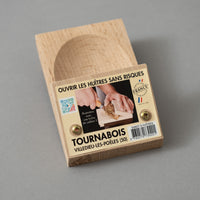
OYSTER SABOT - bronze medal Lépine competition - TOURNABOIS
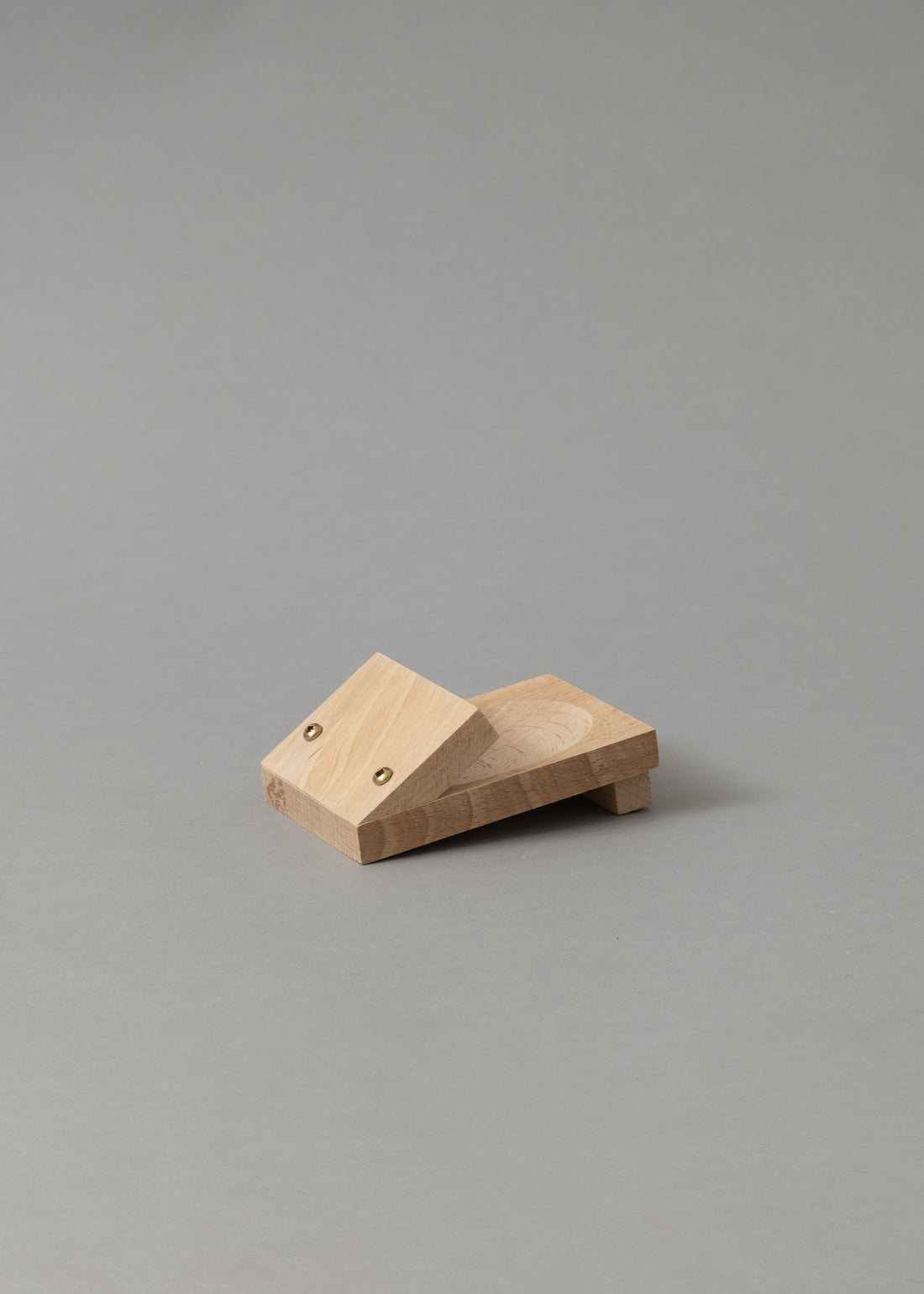
Oyster wedge clog in Norman beech, untreated, this little invention allows you to open oysters without hurting yourself, it won the bronze medal in the Lépine competition in the “nature and art of living” category.
Beech is one of the hardwoods. Very appreciated in small carpentry for its fine and homogeneous grain, it is robust. He is from forest plots managed in a sustainable and responsible manner.
Use :
Position the shoe at the edge of the table, using the stop underneath.
Insert the oyster into the hollow, it is perfectly seated and well maintained.
Insert an oyster knife blade into the joint of the shell: the blade works downwards, under the wooden protection, never towards the hand.
If you make a bad move, the knife sticks in the wood, not in your hand.
Very simple, but terribly effective…
This product was traditional from the Normandy (and Breton…) coasts, but it was no longer produced. Tournabois has relaunched it, and improved it.
- Dimensions: 12.5 x 7 cm
- Material: Norman Beech
- Maintenance: Rinse under water, drain . Not dishwasher safe
Tournabois, artisanal carpentry created in 1950 in Villedieu-Les-Poêles in Normandy. Mainly using local wood species, its businesses are wood turning and machining. At Tournabois, nothing is lost, every waste is recovered. The falls are used to heat the workshop in winter. Sawdust and shavings, coming only from untreated solid wood, are used as natural animal bedding.
Mr Galopin, the boss, is a certified Artisan.
The Tournabois woodwork shop was established in 1950 in Villedieu-les-Poêles, a commune located on the borders of Normandy, Brittany, and the Pays de la Loire, classified as a "Town of Arts and Crafts."
Initially just a sawmill, it quickly evolved into a woodturning shop to supply tool manufacturers (hammer handles, files, and grips) and kitchenware manufacturers (saucepan handles, warming pan handles, and coffee pot handles).
Later, it expanded into woodcraft, meaning the manufacture of small home furnishings: small pieces of furniture, stools, cutting boards, and more.
Taken over in 2015 by Vincent Galopin, a certified master craftsman, the company continues its development in niche markets, where its expertise and quality are recognized.
Tournabois primarily works with local woods: beech, ash, pear, etc.
All wood comes from forest plots managed in a sustainable and responsible manner.
At Tournabois, nothing is wasted; every bit of waste is put to use. Scraps are used to heat the workshop in winter. Sawdust and shavings, which come exclusively from untreated solid wood, are used as natural animal bedding.
Tournabois' goal is to promote French manufacturing. An external, independent auditor checks compliance with ecological commitments and the quality of the company's products every year.