


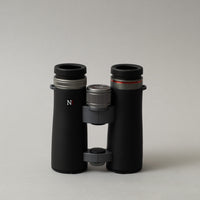


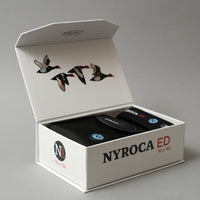
NATURE & ORNITHOLOGY BINOCULARS - NYROCA ED - 10x42 - PERL
PERL NYROCA ED 10x42: An exceptional image, nature as it deserves to be seen.
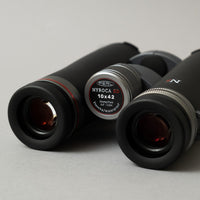
10x42 with ED optics, the combination for the most demanding nature observers. 10x magnification so you don't miss a thing: the detail of a jay's feather, the whiskers of a marmot, the vibrant colors of a kingfisher... ED glass for an ultra-bright, strikingly realistic image! Sharp contours even in difficult light. Enough field of view to never lose a bird in flight.
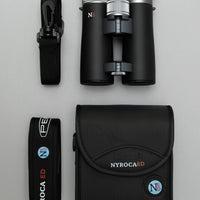
Very solid design, immediate ease of handling. Nitrogen-purged waterproof body: resistant to rain, fog, and temperature fluctuations. Minimum focus at 1.5 meters, right down to the veins on a dragonfly's wings. Supplied with bag, neoprene strap, and microfiber cloth.
HOW TO UNDERSTAND & USE YOUR BINOCULARS, to be read after the description 👇🏼
Technical specifications
- Magnification: 10x
- Objective diameter: 42 mm
- Optics: ED (extra-low dispersion) glass
- Prisms: BaK4, dielectric coating + phase correction
- Field of view at 1000 m: 115 m
- Minimum focus: 1.5 m
- Eyecups: twist-up
- Waterproofing: IPX7, internal gas (nitrogen)
- Tripod mountable: yes
- Supplied with: bag, neoprene strap, microfiber cloth
- Warranty: 10 years
Perl, a French brand for nature observation since 1964
Jean Médas founded Perl in Vichy in 1964. An optician and pioneer, he was one of the first in Europe to offer observation instruments to the general public. Three generations later, design and customer service are still provided from Vichy.
Referenced by the LPO (Ligue pour la Protection des Oiseaux - French Bird Protection League) among its recommended instruments, Perl has been equipping ornithologists, naturalists, and nature lovers for over 60 years. A reputation built in the field.
Understanding the numbers
8x42, 10x42 — two simple numbers. The first is the magnification: an 8x brings things 8 times closer, a 10x brings them 10 times closer. The second is the diameter of the objective lenses in millimeters: the larger it is, the brighter the binoculars. Note: the higher the magnification, the smaller the field of view — you see further, but less wide. In practice, the difference between an 8x and a 10x remains subtle: both offer a very comfortable viewing experience.
How to use your binoculars
For perfect vision, it's very easy; you just need to get the hang of it:
Twist-up eyecups — ALWAYS EXTEND THEM, IT IS ESSENTIAL. If you are nearsighted, farsighted, or have presbyopia: remove your glasses and extend the eyecups. If you have astigmatism: keep your glasses on and fold the eyecups down.
Adjusting the interpupillary distance — Move the two barrels apart or closer together until you see a single, perfect circle.
Adjusting the difference in vision between your two eyes:
- Close your right eye, turn the central focus wheel until the image is sharp for your left eye
- Then close your left eye and fine-tune using the ring on the right eyepiece
- Only do this once! After that, it is set
Focusing — Keep both eyes open and fine-tune with the central wheel, depending on the distance of your subject.