


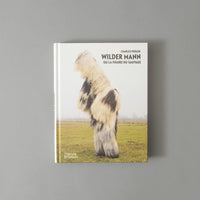
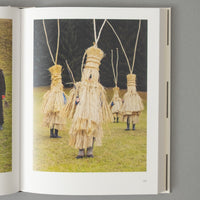
WILDER MANN OR THE FIGURE OF THE SAVAGE - CHARLES FRÉGER - 2012
"Wilder Mann, or, The Figure of the Wild" by Charles Fréger is a photographic slap in the face. This book reminds us, with raw beauty, that our way of life and our freedom are rooted in these traditions that bind Man to the earth, here and now.
While the collective imagination often associates masked rituals and ancestral costumes with ancient and distant cultures (Africa, Asia, the Americas), the work of Charles Fréger is a revelation: it proves to us with staggering force that this mythological "wildness" and these spectacular pagan traditions are deeply rooted in our own European history and folklore and continue to be embodied, right next door, from France to the Balkans!
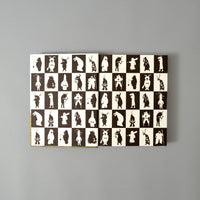
For two years (2010-2011), Fréger traveled through eighteen countries to immortalize men who, on the occasion of festivals linked to the cycle of the seasons, the fertility of the land, and the connection to wild nature, transform into half-man, half-beast creatures.
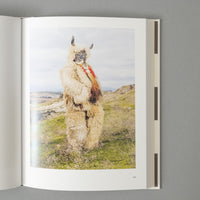
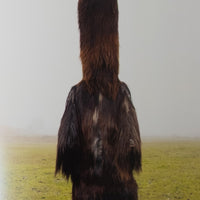
The men are photographed in their rural environments, dressed in archaic and spectacular costumes made of animal skins, furs, horns, bells, straw, or vegetation. From the Pyrenean bear to the Austrian Krampus, via the Bulgarian Babugeri, the work reveals a gallery of "wild men" who embody the forces of nature. Each portrait is both an anthropological study and a work of art, magnifying the raw beauty and richness of these little-known traditions.
The characters are often incarnations of animals (bear, deer, goat) or forest spirits. The book recalls the ancestral importance of the balance between Man and his natural environment, where ritual figures serve to chase away winter, ensure abundance, and awaken nature.
-
Dimensions : 23 x 18 cm
-
Number of pages : 272 pages
Biography of Charles Freger 👇🏼👇🏼
Charles Fréger, born in 1975 in Bourges (France), is a contemporary photographer whose work is internationally recognized for its serial and typological approach to social groups and identity.
He trained at the École Régionale des Beaux-Arts (ERBA) in Rouen, graduating in 2000. It was during his studies that he began to develop the shooting protocol that would become his signature: the full-length frontal portrait of the subject, isolated from their immediate context, often against a neutral background or in a minimal environment, to focus on the uniform or costume.
His Artistic Approach, Uniform as Identity:
Almost all of Fréger's work revolves around the question of uniform and clothing as a marker of belonging. He is not so much interested in the individual as in how they integrate—or blend—into a collective through their standardized appearance.
His methodical and quasi-scientific approach recalls the work of German photographers such as August Sander, but Fréger adds a strong aesthetic and poetic dimension, magnifying the photographed figure.