
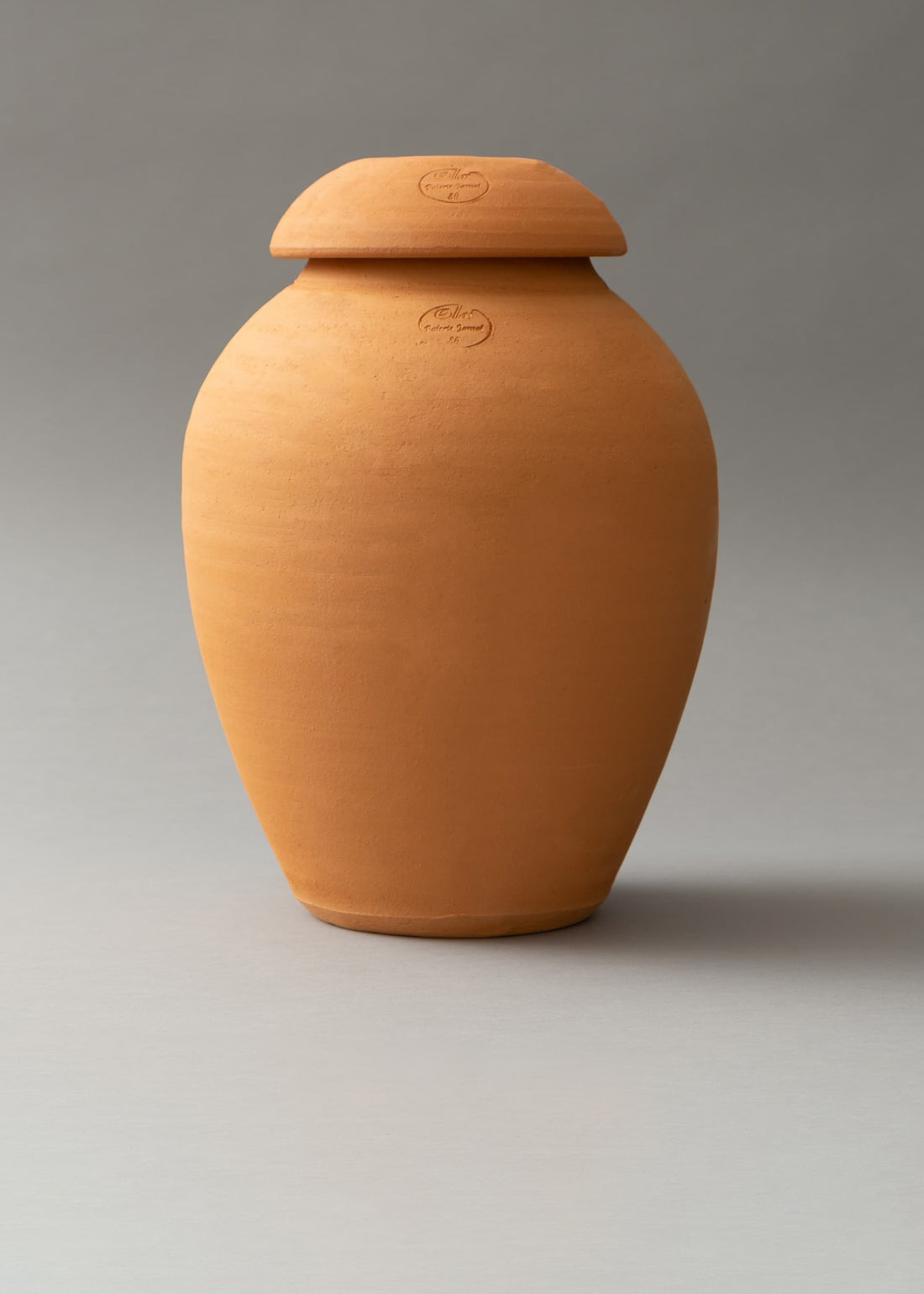

OLLAS ORIGIN N°6 - 12 liters - POTERIES JAMET
Capacity: 12 L
Diameter x Height: 28.5 x 39 cm
Irrigation diameter: 200 cm
Average autonomy: 15 days
Using Ollas (or Oyas) pottery is an ancient underground irrigation technique, highly water-efficient and suitable for all gardens and plantings.
The ORIGIN® Jamet Ollas ceramic is buried and filled with water up to the neck to irrigate the plants placed around it. Its specifically porous walls allow water to slowly seep out to be absorbed by the roots. Say goodbye to water stress; you will save 50 to 75% of water depending on the soil.
No more leaking plastic watering systems or electronic timers that fail to turn on!
A natural system full of the ancient wisdom that sought to conserve both resources and human energy.
Laurent Jamet, heir to a long family tradition of potters, works the clay entirely by hand. Except for the crushing and mixing of the clay, there are no machines in the workshop.
Raw clay extracted from 100% French quarries.
Handcrafted in Anjou, France.
- Water: 50 to 75% savings depending on soil and plant type. 100% of the water serves to moisten the soil, with no evaporation. Use with good mulch.
- Time: Watering is 7 to 8 times faster than traditional watering, with no time constraints.
- The largest irrigation surface areas, up to 3m per Olla, and the longest autonomy on the market, up to 38 days (Ollas No. 6, 7, 8 upon request).
- No maintenance required, frost and limescale resistant.
HEALTHIER PLANTS
- Uniform and deep root development.
- Gentle, steady irrigation from below. The roots naturally grow towards the Olla and draw water according to their needs.
- No water stress, constant irrigation.
- Improved health status.
- Reduction in fungal diseases such as downy mildew.
- Nutrition with more minerals.
The Olla was described as the "Best irrigation system in the world" by alternative Nobel Prize winner Bill Mollison, one of the founders of contemporary Permaculture.
OLLAS JAMET ORIGIN® A NATURAL SYSTEM, 100% ecological product with high environmental value.
- Wet the hole and water the soil around it, as you would for a plant. Do this only once, during installation. This helps to quickly initiate hydraulic conductivity in the Ollas action zone.
- Place the Ollas in the center and bury it up to the neck.
- Recommendations: Surround the Ollas with a mixture of soil and compost, and apply mulch to optimize the Ollas' efficiency and limit evaporation.
- Fill the Ollas with water, water the surrounding soil, and place the Ollas lid on top.
- At the end of the season (during wintering), we recommend not refilling the Ollas, except for citrus trees and plants kept in sheltered areas.
- Positioning: The spacing between the Ollas and the plants to be irrigated depends on the size of the Ollas, its radius of action (see specifications table), climatic conditions, and soil type.
- Example: for a medium-sized N° 4 Ollas, spacing varies between 50 cm (sandy soil) and 80 cm (clay soil), and up to 2.5 meters for sprawling crops.
- Remember that roots always grow toward the humid zone.
- Increase the Ollas volume for very dry climates, soil that promotes natural water drainage, and/or plants that require a lot of water.
- Decrease the Ollas volume for temperate climates, soil that retains water, and plants that do not need much water.
For more information, click: here
The story began in 1974 in Anjou, when Laurent’s father, the son of a tile factory worker from the Puy-de-Dôme, founded Poteries Jamet.
In this family business, Laurent Jamet works with a small team, including his wife, his sister, and two master ceramicists who are faithful to his traditional artisanal techniques.
This mastery of family expertise, combined with Laurent’s creativity, allows Poteries Jamet to manufacture everything from Ollas, bee waterers, and Dolias (wine vats) to being among the last to design pots one meter in diameter capable of holding up to 350 liters (the “ponnes”), entirely hand-coiled.
IN THE BEGINNING IS THE EARTH
Just as it is for a gardener, the secret begins with a good knowledge of one’s soil. Laurent Jamet blends three different types to benefit from the flexibility of one, the mechanical strength of another, and above all, the porosity of the third.
These clays, abundant natural materials, come exclusively from French quarries and are free of any pollution.
A rare expertise that these artisans maintain within their small company.