
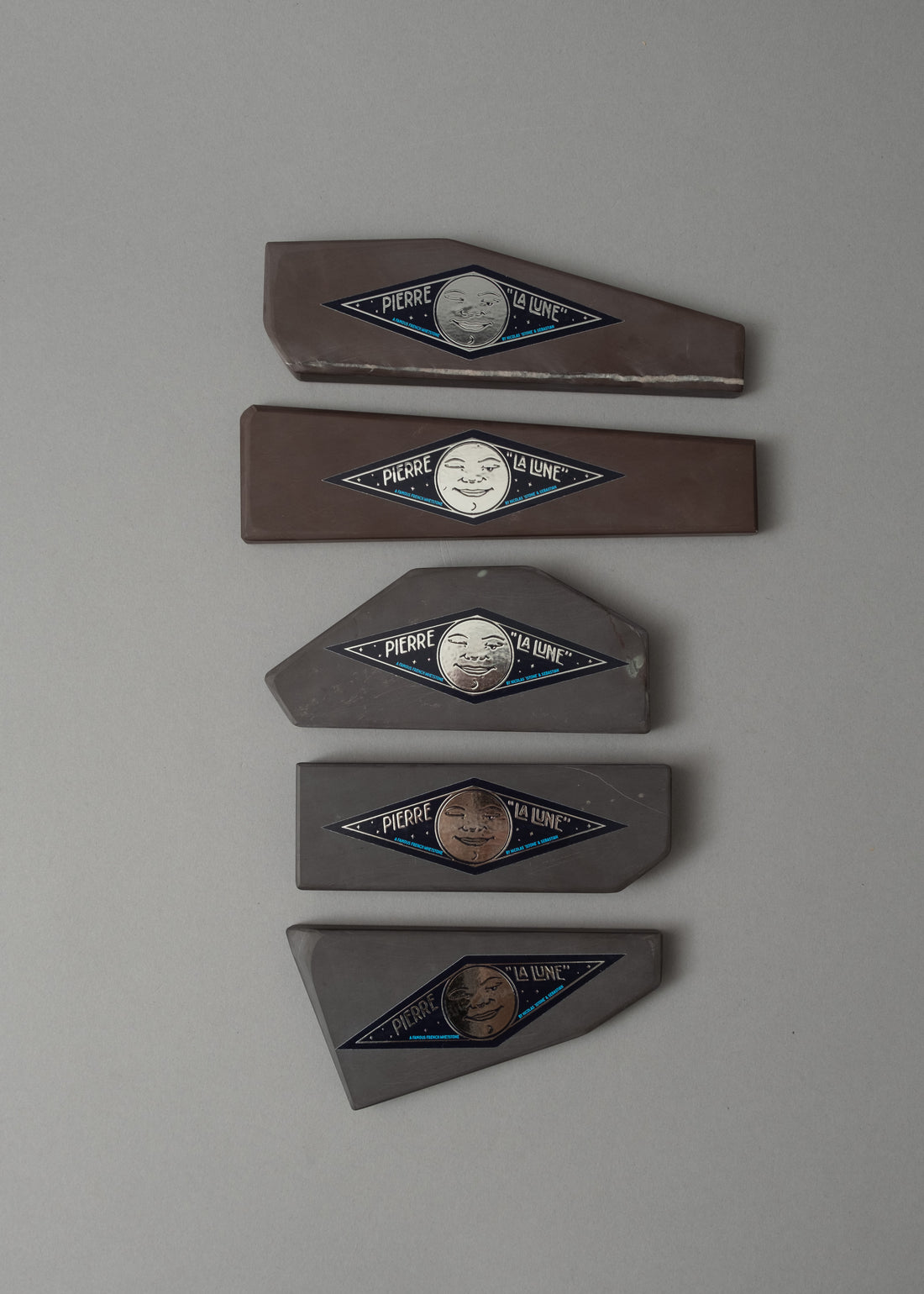
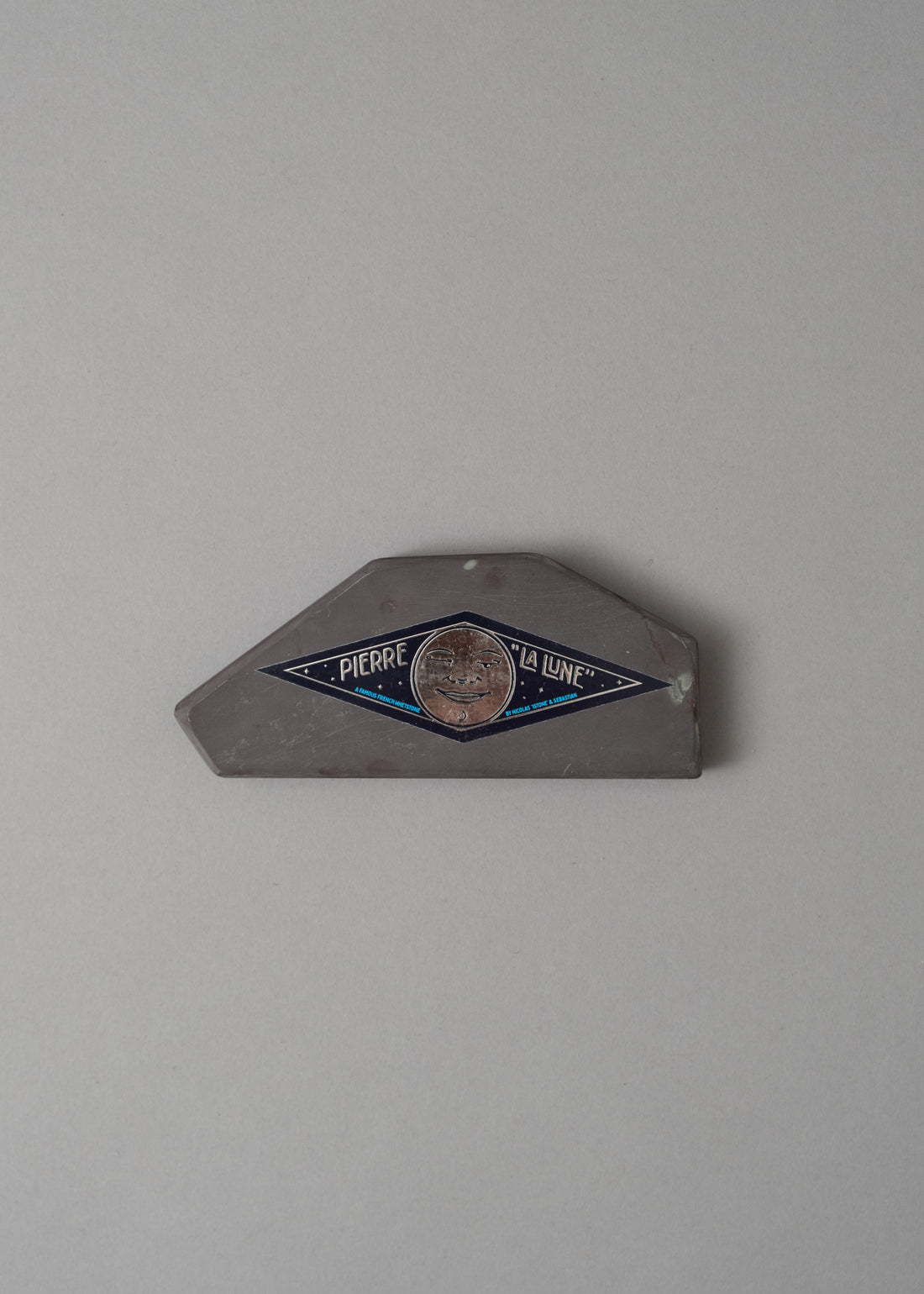


SHARPENING STONE - FREE FORM - THE MOON - GRIT 6000 - 1 STONE
Magnificent "La Lune" natural sharpening stone, 6000 grit for finishing the blade and achieving a razor edge.
This is cut from slate offcuts; its shape is random, but always with a surface area between 65 and 85 cm2.
La Lune stones were historically used by barbers for sharpening razors. Their production ceased in 1984, until Nicolas Rollin decided to revive this forgotten treasure.
"La Lune" slates are the same as those from the last century, sourced from the old slate quarries in Fumay, in the French Ardennes. They are cut and polished by hand by the 1STONE manufacture.
To maintain your knives and enjoy using them, sharpen them regularly—it’s very simple! All the instructions for sharpening are below 👇🏼
- For synthetic stones: soak the stone for a few minutes. For natural stones, run them quickly under water. During sharpening, water prevents steel powder from clogging the pores of the stone and helps create the "slurry" used for sharpening.
- Set up the stone: Get into a comfortable position and place the stone on a non-slip base, such as a damp cloth or paper towel.
- Position the blade on the stone: hold the handle with one hand and place 2 fingers of the other hand near the blade's edge. Your fingers control the pressure against the stone while sharpening. The blade should have an angle of attack of about 20° relative to the stone. Unless you have a perfect eye for angles, just remember that the most important thing is to always maintain the same angle—be CONSISTENT!
- Find the right motion: Slide the blade across the stone in a slight arc. Move back and forth, from the base of the blade to the tip, applying very light pressure with your 2 fingers. Then, flip the knife and perform the same number of strokes on the other side. Otherwise, your sharpening will be asymmetrical.
- If needed, dampen the stone during sharpening; it is the slurry created by the steel dust and water that sharpens. For natural stones sold with a "NAGURA," rub it against the stone to create the slurry.
- For a razor edge, move to a fine grit, 3000 or higher. And for the enthusiasts, finish it off with a leather strop!
- Do the paper test: the blade should slice through a sheet of paper without tearing it; if not, repeat the process.
- Finally, if it is a carbon steel blade, dry it thoroughly and coat it with a lubricant, such as camellia oil, though sausage fat works just as well ;)
A former baker, Nicolas Rollin was passionate about sharpening stones. His enormous collection was surely the largest in Europe.
It was natural for him to train in the manufacturing of natural stones in Germany, where he learned how to cut and polish them.
He honed his skills for several years alongside his job as a baker, then rediscovered the trail of the "Moon Stones," a piece of French historical heritage whose production had ceased in 1984.
He decided to set out on his own to revive this forgotten treasure. "La Lune" slates are the same as those from the last century and come from the old slate quarries of Fumay in the Ardennes. As these quarries were no longer active, he obtained permission to operate them thanks to the village mayor, who also wanted to see the history of this unique stone reborn.
Since then, Nicolas has expanded his offering; he also works with Japanese natural and synthetic stones, renowned for their exceptional quality.