


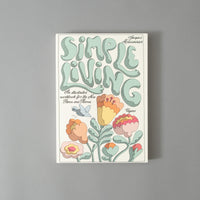
SIMPLE LIVING - JACQUES MASSACRIER - 1973
The cult book by Jacques Massacrier, republished 50 years later, has never been more relevant.
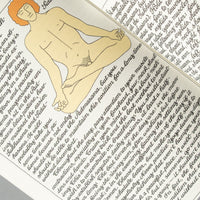
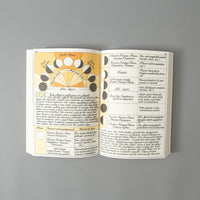
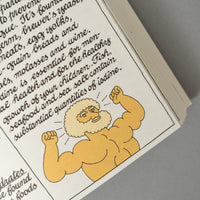
Entirely hand-lettered and hand-drawn, this book is a graphic gem and a bible of self-sufficiency. Every aspect of daily life is covered — shelter, making everyday objects, food, clothing, healthcare, and more. Essential for every bookshelf. Let's carry on Jacques' work by following the teachings of this idealistic and visionary pioneer.
- 21 x 31 cm format
- 200 pages
"What is the point of raising the alarm against consumer society and the pollution it generates, if we continue to support the industries that poison us and exhaust our planet's natural resources? Let us not waste what little oxygen we have left crying out our distress. Let us instead relearn to live without the products of these industries, and rediscover, in contact with nature, the foundations of a true scale of values. Certainly, we will struggle to do without manufactured goods entirely — we have accumulated too many bad habits over generations. But let us imagine an industrial production limited to essential things. Not easy to determine, since we have precisely lost our sense of what is essential. But let us set aside our accumulated knowledge for a moment and reflect on how we use it. Let us reconsider the fundamental elements of our existence." — Jacques Massacrier
What is the point of raising alarms against the society of consumption and industrialization, against the resulting pollution, if we continue to support the industries that poison us and deplete our planet's natural resources!
Why nourish the weeds that choke the vegetables in our garden?
In the tumult of the indifferent crowds of big cities, complaints are no longer heard, so let us not waste the little oxygen we have left crying out our distress.
Let us instead relearn how to live without the products of these industries and rediscover, through contact with nature, the foundations of a true scale of values; faced with the marvelous biological balance, we will be able to measure the immensity of the disorder of our society.
Admittedly, we will struggle to do completely without these manufactured products; we have accumulated too many bad habits over generations.
Perhaps we should not eliminate industrial production entirely in the common interest, limiting it to essential things, but how can we determine them since we have precisely lost the notion of what is essential?
Let us put our knowledge on hold and go meditate on the appropriateness of its use. Let us reconsider the primordial elements of our existence.
You must have a well to know the value of water... You must grow a tree to hesitate before cutting down another... You must savor the vegetables from your garden to know what substitutes we were accustomed to... You must chop your own wood to rediscover the true sensation of comfort before your fireplace... You must make your own clothes to no longer want to submit to the whims of fashion... You must watch animals and insects live before exterminating some so-called "pests"... You must regain the health of body and mind to realize the pleasure of living and that of loving.
Every year, hundreds of thousands of people become aware of the sterility of their social lives, experience a premonition of the great upheavals or cataclysms that spare only primitive peoples, and they set off to relearn how to live organically in nature.
This nature that most have only approached during vacations and weekends; those who have never grown anything but a bean in a piece of damp cotton at primary school; those who would like to build a wall but do not know the proportions to make cement; those who have always thought that a rooster was needed in a henhouse for hens to lay; those who are helpless when they do not have a doctor to treat the slightest ailment; those who imagine that one must be a tailor to make pants or a baker to make bread...
...This book is intended for them; it will teach them simple and elementary things, the basic elements that are generally formulated in a way that is too complex for the "uninitiated" in specialized works, recipes and various tips gathered from those who have lived the adventure by escaping the cities; they learned to live again with nature themselves and offer us in this book the solutions to the difficulties they encountered.
In fact, it is a matter of replacing commercial products as much as possible with what can easily be done oneself; one should not expect to be able to live from one day to the next on one's own production, but one can quickly reduce one's financial needs to a strict minimum (especially those living in a community).
By returning close to nature, we contribute to protecting it, we reintegrate into our natural element and stop collaborating with a society whose vitality is based on waste. We are perhaps the pioneers of a great migration toward a better world that is at our doorstep.
Man persists in inventing Hell in a paradisiacal world.
Jacques Massacrier was born in Paris in 1933. He studied graphic and applied arts. He was an art director at the Publicis Champs-Élysées agency from 1953 to 1968. Invited to Ibiza by friends for the 1968 Christmas holidays, he was captivated by the beauty of the landscape and the kindness and tolerance of the population, which at the time was essentially rural. A Parisian, he left everything behind in 1969 to go live with his family in the heart of nature. They rented an old farmhouse lost in the countryside and lived for 17 years without running water or electricity. In 1973, he published an illustrated book with Albin Michel titled "Savoir revivre" ("Learning to Live Again") about the return to nature, which was a huge success at the time. He was honored with the cover of Paris Match and gave numerous media interviews. Since then, he has written nearly sixty novels and short stories and an autobiography.