
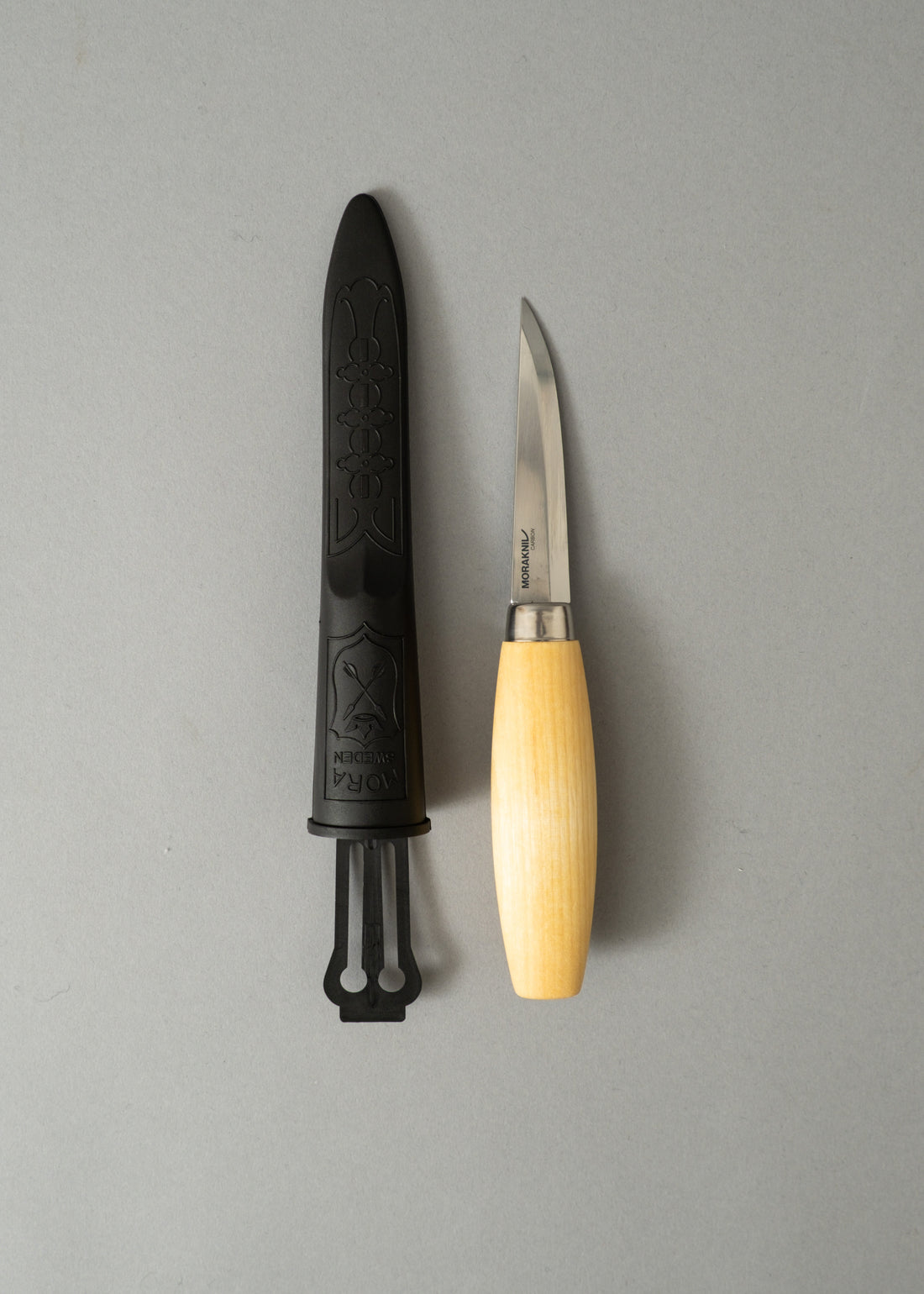
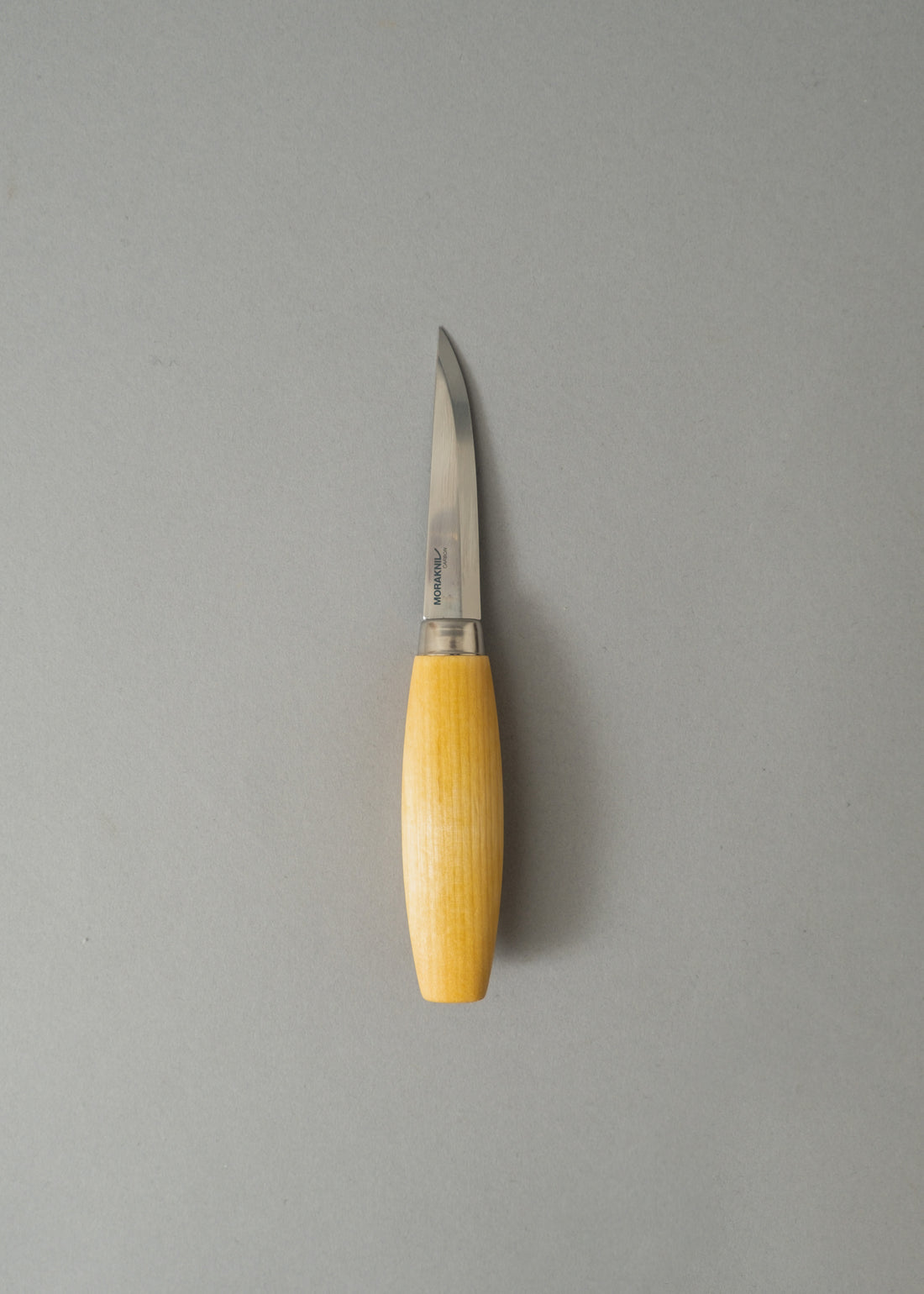


WOOD CARVING KNIFE - MORAKNIV 106
The iconic Morakniv carving knife, the gold standard for woodworking enthusiasts, whether amateur or professional,
Highly efficient and precise with its 8 cm blade and through-tang, and its large, ergonomic birch handle, it handles the most difficult tasks with great control over the cut,
It is traditionally used for carving "Dala" horses, traditional Swedish wooden figurines,
Carbon steel blade, very sharp and durable, easy to sharpen,
Tip: use green wood, which is much easier to carve.
Get comfortable by the fire and unplug.
Be careful with maintenance; carbon steel oxidizes easily.
- Knife Type: Woodcarving knife
- Full tang: The blade extends to the end of the handle
- Usage: Woodcarving, outdoor, DIY,
- Total length: 190 mm
- Blade length: 82 mm
- Handle length: 108 mm
- Blade thickness: 2.5 mm
- Material: Carbon steel
- Handle: Oiled natural birch (linseed)
- Sheath: Polymer sheath
- Sharpening: Scandinavian grind, very easy to sharpen without a guide
- Knife weight: 55 g
- Total weight with sheath: 72 g
- Handmade in Sweden
- Hand wash with water, no dishwasher, no detergent
- Clean the blade with water after each use, especially if it has come into contact with corrosive foods (citrus fruits)
- Avoid soaking the handle or the blade
- Dry thoroughly, as this is very important to prevent the carbon steel from oxidizing
- Store individually
- Protect the blade with our camellia oil or a protective oil if you are not using it regularly
- Sharpen regularly; don't wait until it loses its edge so you can keep the blade longer!
- Sharpening: Scandinavian grind, very easy to sharpen without a guide, simply lay the edge of the blade flat on the stone.
The town of Mora in Sweden has been a center for knife manufacturing for many centuries. Naturally superior Swedish steel, combined with artisanal craftsmanship, has given rise to knives that have become famous for their ability to maintain a superior edge and be easily sharpened.
Traditionally made, all Morakniv knives with a wooden handle are assembled by hand. The technique has not changed since 1891.
"FORM FOLLOWS FUNCTION" Louis Sullivan, 1896.
This quote could have inspired the style of Frost-Erik Erson when he created his first knives in the small town of Mora in 1891, after working for 4 years as a lumberjack in North America.
At that time, these utilitarian knives placed function before style. But the simplicity of functionality, combined with high-quality craftsmanship, creates a unique beauty—an essential beauty that endures through the ages without ever fading.
The blacksmiths of Mora developed a functional style that became a great classic, known simply as the "Mora Knife." Until recently, there were two major companies in Mora, KJ Eriksson and Frosts of Mora. They merged into "Mora of Sweden," now known as "Morakniv."
The manufacturing tools have been modernized, but the quality and traditional assembly techniques for wooden-handled knives remain unchanged.
Today, Morakniv knives are the benchmark for outdoor knives, used as much by bushcraft professionals, wood carvers, and construction workers as by the Swedish army, for whom they are an essential companion in the daily life of soldiers.