
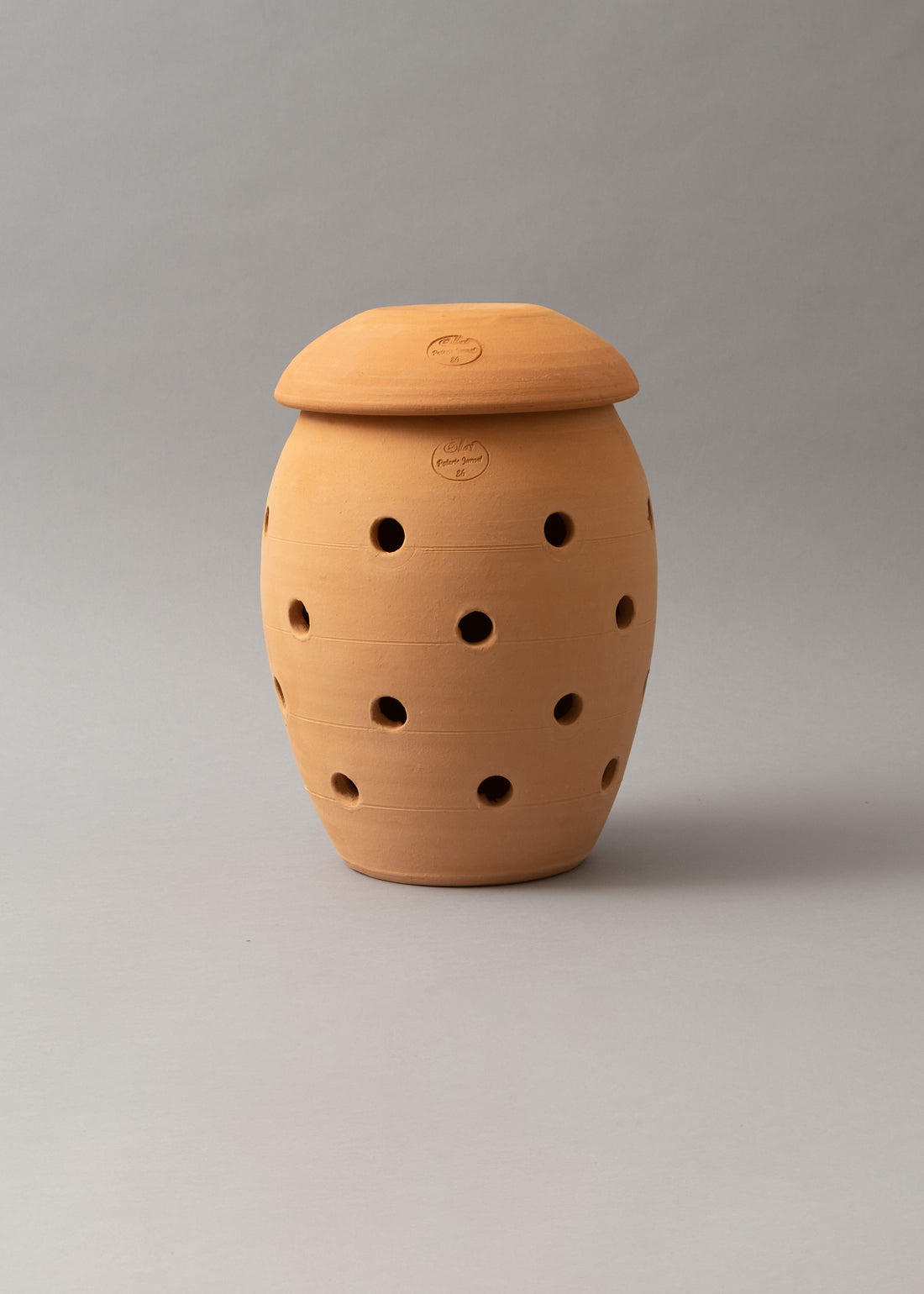

COMPOSTER TO BURIED - 9 LITER - POTERIES JAMET
This new generation of terracotta composters is ultra practical for recycling all your plant waste and effective for fertilizing your plants,
Buried in the ground in your garden, in the vegetable patch or in your planters, it will directly nourish the plants around it, and you can recover the compost created inside to spread it at the base of your crops, the best natural fertilizer !
- Bury the composter almost up to the neck
- Fill with your peelings and plant debris, cut into small pieces to speed up the work of the worms (Attention: for planters you will need to add worms)
- When the composter is full, remove your compost and bury it at the foot of your crops, and that's it 🪱🌱
3L or 9L capacities:
- 3L / diameter at widest = 15 cm / height = 22 cm / Opening diameter = 11cm
- 9L / diameter at widest = 26 cm / height = 32 cm / Opening diameter = 17cm
Laurent Jamet, heir to a long family tradition of potters, only works the clay by hand. Except for grinding and mixing the earth, there is no machine in the workshop.
Raw earth extracted from 100% French quarries.
Handcrafted in Anjou, France.
The story began in 1974 in Anjou, when Laurent’s father, the son of a worker in a Puy-de-Dôme tile factory, founded Poteries Jamet.
In this family business, Laurent Jamet works with a small team, including his wife, his sister, and 2 master ceramists who are faithful to his traditional artisanal techniques.
This mastery of family expertise, combined with Laurent's creativity, allows Poteries Jamet to manufacture everything from Ollas, bee waterers, and Dolias (wine vats) to being among the last to design one-meter diameter pots capable of holding up to 350 liters (the “ponnes”), entirely coiled by hand.
IN THE BEGINNING IS THE EARTH
Just as it is for a gardener, the secret begins with a good knowledge of one’s soil. Laurent Jamet mixes three different types to benefit from the flexibility of one, the mechanical resistance of another, and, above all, the porosity of the third.
These clays, abundant natural materials, come exclusively from French quarries and are free of any pollution.
A rare expertise that these artisans maintain within their small company.